Now that both the budget deadlines and holidays have passed, it is time for local governments to submit their adopted budgets to DLG.
There are resources on budgeting on our website at www.dola.colorado.gov/budgets. There, you will find a checklist of the statutory requirements of budgeting to ensure that DLG receives all of the necessary documents and data.
Once all of your documents are compiled (either in paper, or hopefully, as PDF documents) there are two ways to get them to us. Our preferred option is by using our electronic filing method where you submit the PDF document of your budget (we have successfully received PDF documents upward of 800 pages) with the district name and Local Government Identification Number (LGID) included both in the name of the document itself, and in the email subject line. The other option would be to mail a paper copy, however, in the interest of saving costs, time and preserving resources, we encourage using our electronic filing method.
There is a full list of instructions on our e‑filing page at www.dola.colorado.gov/e‑filing You are able to see our guidelines on naming your document, using PDF documents, and look up your LGID number on our budgeting website ‑ www.dola.colorado.gov/e‑filing.
Note: Please send only one government per email [e.g. XYZ Metropolitan District No.1 ‑ 6 need to send an individual email for each individual district ‑ 1, 2, 3, 4, 5, and 6.], if there is a parent government that includes the budget of another local government [e.g. City of Biggsville includes the budget of the Biggsville Urban Renewal Authority or Local Improvement District, or other...] please note in the email that the budget of the other government/s is included (and include that local government's LGID as well).
Of course if you need of additional help, please contact Jarrod Biggs at 303.866.4493, jarrod.biggs@state.co.us or Cynthia Thayer at 303.866.5601, cynthia.thayer@state.co.us.
Contact information is also on the budgeting page.
Tuesday, January 4, 2011
Wednesday, December 22, 2010
US Census Bureau releases the 2010 counts for the US and its states
Today the US Census Bureau released the 2010 counts for the US and its states.
The count for the US was 308,745,538. This represents a 27.3 million increase over the decade. The change in percentage terms was 9.7 percent.
In percentage terms, this was the second slowest growing decade -- second to the decade of the 30s. In absolute terms however, the 27.3 million ranks third fastest behind the decade of the 90s and the 50s.
For Colorado, the population count came in at 5,029,196 which is a 727,915 or 16.92 percent increase since 2000 and ranks our state as no. nine in percentage change over the decade.
Colorado will not gain or lose a US congressional seat. All other states being equal, we would have had to have a population count of approximately 5.309 million to get an eighth seat.


Tuesday, December 14, 2010
American Community Survey Estimates 5 – Year (2005-09) and Census 2010 data to be released in December 2010
American Community Survey Estimates 5 – Year (2005-09) and Census 2010 data to be released in December 2010.
As many of you are aware, the US Census Bureau will be releasing American Community Survey (ACS) 5-year data on December 14th. This is the first time ACS data, characteristic information, has been made available for every county, city, town, and place, as well as for census tracts and block groups since the Census 2000 data was released in 2001. The ACS has taken the place of the Decennial Census Long Form that asked the detailed social, economic, housing and demographic questions.
Also, the first Census 2010 state counts will be released December 21st to the President for reapportionment purposes. It could be confusing that the two Census products are being released in the same month but it is fairly easy to learn how they are different and when to use each source.
The 2010 Census shows the number of people who live in the U.S. and the American Community Survey shows how people live. Use data from the American Community Survey to obtain demographic, social, economic, and housing characteristics. Use numbers from the 2010 Census to obtain counts of the population and their basic characteristics (sex, age, race, Hispanic origin, and homeowner status). For more information on Census 2010 please visit Census 2010 Main
ACS 5-year Data 2005-09
What does this mean for you, the data user? When is it appropriate and beneficial for you to use this data? We’ve compiled the following list of FAQs to help you understand the 5-year data. If you have additional questions or concerns, please feel free to contact our office: 303-866-3120 or barbara.mason@state.co.us or Elizabeth Garner at 303-866-3096 or Elizabeth.garner@state.co.us.
Q: Where do I find the ACS 5-year (2005-09) estimates?
A: The Census Bureau American Fact Finder site is the best place to start. American Fact Finder. From here, in the center area under “Getting Detailed Data”, select detailed data under the American Community Survey title, then select the ACS 5-year (2005-09). A series of drop downs will help you to select your geography and variable. You can also go to the American Community Survey website for more information and user guides.
Q: How accurate is the data?
A: The ACS is a survey, not a 100% enumeration (such as the 2010 Census, for example). Because only a percentage of the US population is actually surveyed, each data result has an associated Margin of Error (MOE). We encourage data users to consider the MOE and to take it into account when analyzing the 5-year data, as we do with all ACS products.
Q: How recent is the data?
A: The 5-year data being released in December 2010 was collected from 2005 through the end of 2009. This means that, of all the ACS data products, the 5-year data is the least current. As stated above, though, it’s the only ACS data available for the small geographies and populations.
Q: Can I use the ACS data to write a paper/report/article about recent economic, labor market and housing market changes?
A: No you cannot. Because the survey was conducted over such a long period of time, this data is not appropriate for analysis of recent trends, or for time-series analysis. We recommend the 1-year data for purposes of time-series analysis, and the most recent data.
Q: What is the data good for, then?
A: The 5-year data is a powerful and very useful tool for analysis of small areas- counties, towns and neighborhoods that previously only had access to new data every 10 years. It also allows us “wall-to-wall” data coverage across the state.
Q: How often will 5-year data be released?
A: All ACS products are released annually, on a rolling basis. For the 5-year data this means that in 2010 the 2005-2009 data will be released. In 2011, the 2006-2010 data will be released.
Q: What are other good resources for understanding the capabilities and limitations of the ACS 5-year data?
A: Start with the main American Community Survey web page and then click on the tab for “Guidance For Data Users”. From this page there are several resources including an e-tutorial about the ACS and how to download and use the data. There are also “Handbooks for Data Users” depending on your area of interest. You can also contact our office for more information: DLG.HelpDesk@state.co.us or Elizabeth Garner 303-866-3096 or Barb Mason 303-866-3120.
Wednesday, December 8, 2010
Sustainable Main Streets Initiative Event a Success
 |
| Gov. Ritter addresses the audience at the Nov. 30 event celebrating the Sustainable Main Streets Initiative |
DOLA executive director Susan Kirkpatrick joined Gov. Bill Ritter, Lt. Gov. Barbara O'Brien and OEDIT executive director and initiative co-chair, Don Marostica, for the event to highlight the accomplishments of this initiative that was launched just a short time ago in April.
The Five Points neighborhood in Denver, Town of Fowler, City of Monte Vista and City of Rifle, were able to share their accomplishments, goals and next steps.
Gov. Ritter praised the communities for their hard work and extended his appreciation to DOLA's staff for laying the groundwork for this new and improved way of doing business to help communities gain better access to state and other resources.
To read more about the Sustainable Main Streets Initiative, be sure to check out the web page. To read Gov. Ritter's announcement, click here.
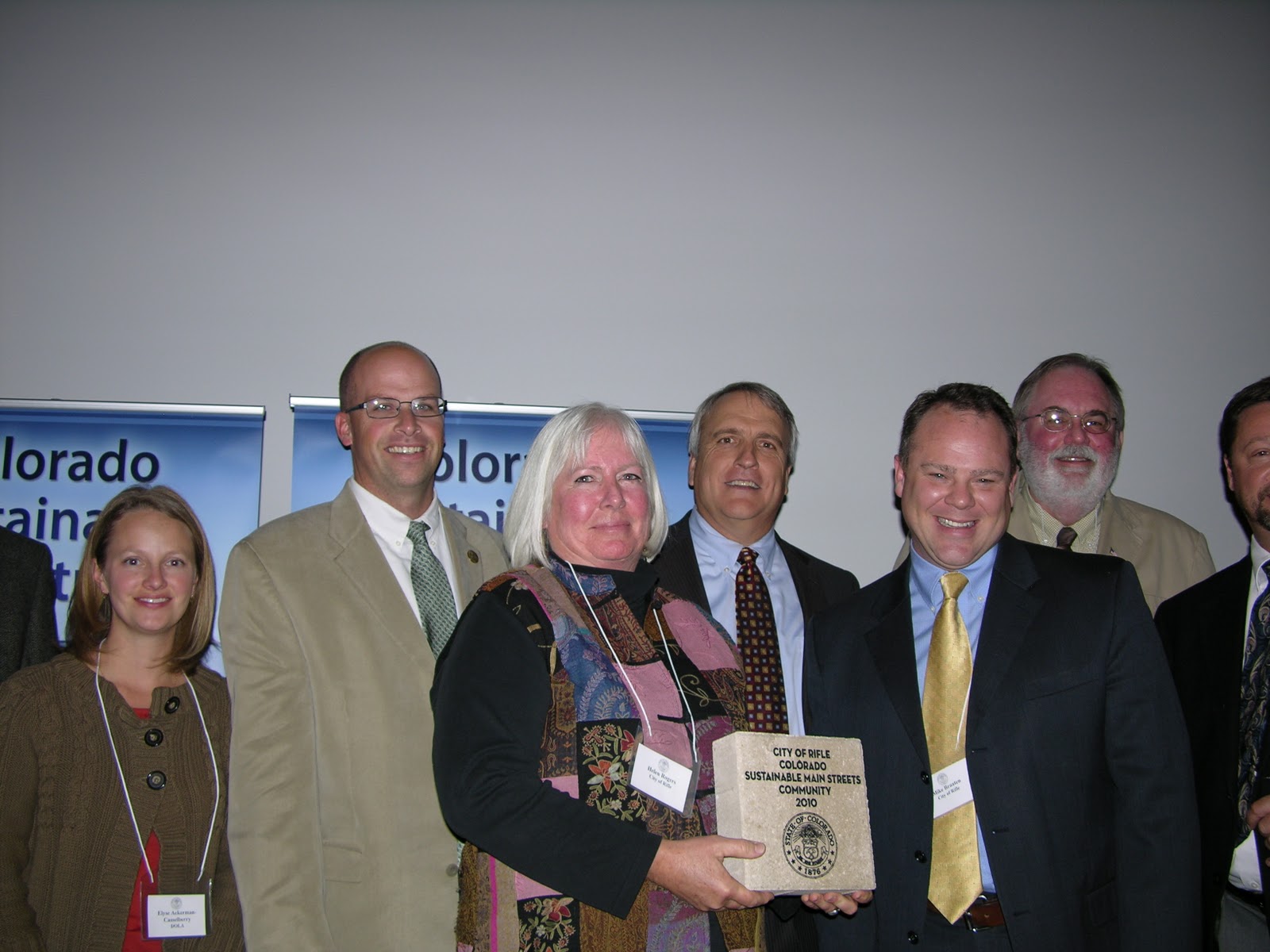 |
| DOLA Regional Manager, Elyse Ackerman-Casselberry, joins representatives from the City of Rifle |
 |
| DOLA Executive Director Susan Kirkpatrick (center) joins representatives from the Five Points community |
 |
| Susan Kirkpatrick presents an award to Fowler's Mayor, Pat Christensen (center), and representatives from the Town of Fowler |
 |
| Susan Kirkpatrick and representatives from the City of Monte Vista celebrate their Sustainable Main Streets Initiative award |
Wednesday, December 1, 2010
Monday, November 15, 2010
Tuesday, November 2, 2010
Town of Red Cliff Celebrates New Water Treatment Facility at Ribbon Cutting

Red Cliff Mayor Ramon Montoya, left, and Charles Unseld, deputy director of Colorado's Department of Local Affairs, share the ribbon cutting responsibilities for the new Red Cliff $4.2 million wastewater treatment plant Friday in Red Cliff. Federal stimulus dollars from the American Recovery and Reinvestment Act covered a majority of the project's cost. State and local grants paid for the rest. R.N. Civil Construction based in Centennial started work on the plant in 2009. The town's old treatment plant dated back to the '70s and had long been considered a scourge to the environment.
Dominique Taylor/dtaylor@vaildaily.com
Subscribe to:
Posts (Atom)
